
- Reasonable selection of high-precision imported bearing application methods
- Tolerance fit between bearings and shafts, bearings and holes
- What are the properties and requirements of bearing steel
- The rolling sound of the bearing can determine the fault
- High temperature may cause irreversible damage to bearings
- Should bearings be selected in this way?
- Debugging and measurement of bearing usage
- The impact of the quality of bearing configuration on operation
- What kind of rolling bearings have repair value?
- The benefits of collaborating with professional bearing manufacturers
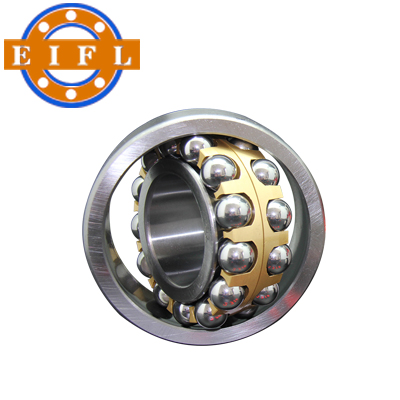
Self-aligning ball bearing
Self-aligning ball bearing is a double row ball bearing with a spherical outer raceway and two deep groove inner raceways, which has self-aligning performance.
TEL:+86 15562622888
Self-aligning ball bearing is a double row ball bearing with a spherical outer raceway and two deep groove inner raceways, which has self-aligning performance. It is mainly used to withstand radial loads, and can also withstand a small amount of axial loads while bearing radial loads, but generally cannot withstand pure axial loads. Its ultimate speed is lower than that of deep groove ball bearings. This type of bearing is commonly used on double support shafts that are prone to bending under load, as well as in components where the double bearing holes cannot guarantee strict coaxiality, but the relative inclination between the inner ring centerline and the outer ring centerline must not exceed 3 degrees.
Basic types of self-aligning ball bearings
12. The inner hole of the 13, 22, and 23 series self-aligning ball bearings can be cylindrical or conical. The self-aligning ball bearing with a taper of 1:12 (code suffix K) can be directly installed on a conical shaft or installed on a cylindrical shaft through a tightening sleeve. FAG can provide not only unsealed self-aligning ball bearings, but also basic types of self-aligning ball bearings with sealed covers at both ends (code suffix 2RS).
Self aligning ball bearings with bearing clearance
The basic type of cylindrical hole self-aligning ball bearing is manufactured with a common clearance group, and bearings with larger radial clearance than the common group (code suffix C3) are supplied with cables. The basic type of tapered hole is the C3 group, which has a larger radial clearance than the ordinary group.
Sealed self-aligning ball bearings
Sealed self-aligning ball bearings (code suffix. 2RS) are equipped with sealing covers (contact seals) at both ends. To ensure their lifespan, lubricating grease has already been added in the manufacturing plant. The minimum operating temperature limit for sealed bearings is -30 ℃.
Alignment of self-aligning ball bearings
The self-aligning ball bearing allows the shaft to deflect 4 ° around the center of the bearing, while the sealed self-aligning ball bearing can compensate up to 1.5 °.
PREVIOUS: self-aligning ball bearing
NEXT: Thrust ball bearing